Domestic market, constrained cross-border capital
Moscow
The commercial capital and the Skolkovo project. Sanctions sit on the cross-border half of any deal.
BRICS
A domestic technology market operating under sanctions that cut ordinary cross-border venture finance, payments, and a wide set of technology exports.
Startup EcosystemsRussia
Russia still has company law, engineers, and a large domestic digital market. What it does not have, for a reader who lives under United States, European Union, or United Kingdom jurisdiction, is an ordinary path for venture capital to go in and come out. OFAC maintains a Russia-related sanctions programme. The Council of the European Union maintains restrictive measures. The United Kingdom maintains its own. The lists and licences change. This page does not reproduce them and is not a sanctions opinion.
The practical effect is enough to state without a legal conclusion. Dollar and euro clearing, many technology exports, dealings with designated persons, and the willingness of regulated funds to hold Russian risk are constrained. A term sheet that ignores the investor’s home-state law is not a plan. Domestic capital and state programmes still finance companies that sell inside the country.
Skolkovo, on the edge of Moscow, is a federal innovation centre run by a foundation. The foundation’s own site describes participant services, from acceleration to customs help. GRIP does not adopt the centre’s description of its own scale. It is a designated zone with a political sponsor. It is not a substitute for market access, and it does not lift sanctions on a foreign investor.
Separate urban systems, in the order they are discussed.
The same ten questions for every major cluster. Answers are qualitative. They are not scores, and they do not rank countries against each other.
Moscow is the commercial capital, the usual university citation, and the site of the Skolkovo project on the city’s edge. St Petersburg has institutions and is not given a separate brief. A second city page would not change the sanctions fact.
The sectors that can still be built are those that do not need a restricted component, a foreign cloud, or a foreign app store: domestic software, domestic payments, and industrial substitutes for products that left. A sector described as ‘leading’ in a pre-2022 ranking is not evidence about the present.
Capital that does not cross a sanctioned banking relationship is domestic: Russian funds, companies, and state development tools. Investors subject to US, EU, or UK measures should assume a wire fails until counsel shows a licence. GRIP does not describe a workaround.
Technical education is deep. Paying a cross-border team, or hiring people who have left, is the constraint. No emigration statistic is quoted. The payment failure is sufficient.
Ordinary company forms still exist. They sit under domestic rules on data and platforms and under foreign sanctions programmes that GRIP does not reprint. OFAC and the Council of the European Union are the public indexes. They are not a substitute for a lawyer.
The customer that remains is inside the country. No market-size figure is printed. Export to states that will still clear the payment is a political and logistical project, not a default scale-up.
Air links and software distribution toward the United States, the EU, and the UK are not a normal commercial network for a sanctioned economy. Domestic rails replaced some foreign services. Replacement is not interoperability.
Moscow-City is offices, not an innovation policy. Skolkovo is a foundation-run centre with a public sponsor. Power and domestic hosting can be enough for a domestic product and irrelevant to a product that assumed a Western cloud.
Sanctions, export controls, and the inability to pay or be paid in dollars or euros dominate every cross-border sentence. Domestic political rules on information are the other constraint. Neither is a cycle that a founder waits out on a slide.
A domestic market can still support companies that sell only at home and do not need foreign shareholders. That is a limited potential, and it is not an invitation. Cross-border potential, for readers under US, EU, or UK law, is a legal question that this research does not answer in the company’s favour.
Founders continue to incorporate and to sell to Russian customers, including where foreign software and payments have withdrawn. That is import substitution as a commercial fact. It is not evidence that a foreign fund can participate.
Limited liability companies and joint-stock companies are the ordinary forms. A foreign shareholder now has to ask, before the form, whether the investment itself is permitted from the investor’s side and whether the Russian side can pay the shareholder anything later.
Cross-border venture from the United States, the EU, and the UK is the exception that has to be licensed, if it is possible at all. Domestic investors, corporate buyers, and state development institutions are the capital that remains inside the system. Their objectives are not the same as a financial fund’s.
The stack that can still be built is the stack that does not depend on restricted components, cloud regions, or app stores. Payments have been redirected toward domestic rails. Software that assumes a Western cloud is a different product from software that does not.
Technical education remains deep. The constraint reported by firms outside Russia is that many of the people they want to hire no longer want the Moscow employment contract, or cannot be paid across the border. GRIP does not quote a migration figure. The payment problem alone is enough to break a cross-border team.
Moscow and St Petersburg concentrate the institutions foreign researchers would recognise. Collaboration with those institutions is itself restricted for many public funders and universities in sanctioning states. A joint lab is not a neutral academic detail.
Domestic regulation of platforms, data, and ‘foreign agents’ has tightened in the same years as external sanctions. A product that handles speech, news, or personal data inherits both regimes. Neither is advisory content GRIP will summarise into a checklist.
Rents and salaries in roubles are a domestic fact. The cost that dominates a cross-border conversation is the inability to pay or to be paid. Doing Business ranks are not used. They would also describe a pre-sanctions legal fiction.
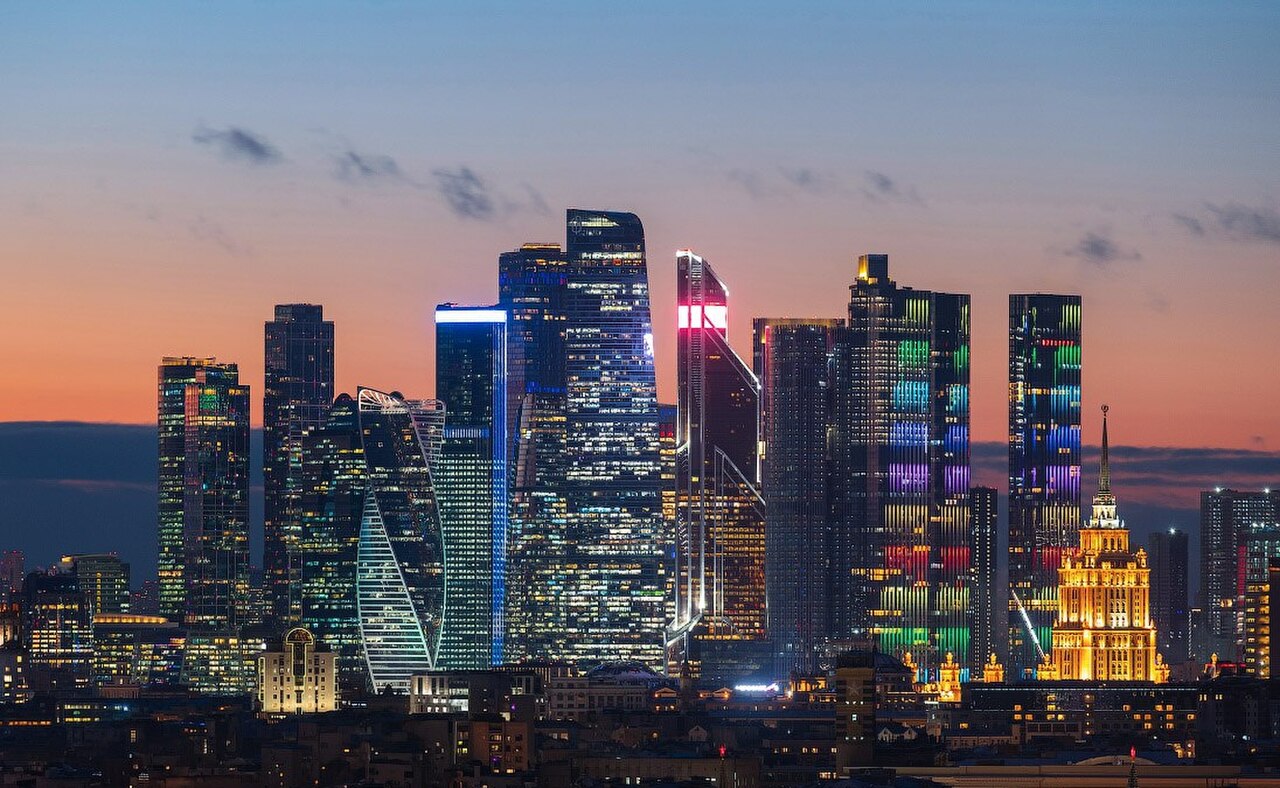
The towers in the photograph are commercial real estate. They are not an innovation policy. Digital infrastructure works inside the country on domestic substitutes where foreign services have withdrawn. Cross-border hosting and cross-border app distribution should be assumed broken until a lawyer shows otherwise.
The customer that remains is domestic: households, firms, and the state. Export of technology to ‘friendly’ markets is a political and logistical project. It is not the default scale-up path it might have been described as before 2022.
Where foreign products left, local substitutes were written. Some of that is genuine engineering under constraint. Some of it is a captive market. A research note should say which one it is looking at, and should not call a captive market a global product.
Scale inside Russia is possible for a company that does not need foreign payments, foreign components, or a foreign store. Scale that includes a foreign shareholder in a sanctioning state is a legal question first and a commercial question second. GRIP does not invite that shareholder in.
Across GRIP
The same place, read from another desk.
Continue with GRIP
Country briefs are the law and the national system. City briefs are where hiring, customers and rent actually happen.