GRIP LibraryMarkets and cities
A GRIP Special Edition
Zimbabwe: The Country Beyond the Balance Sheet
Zimbabwe deserves to be understood through more than its currency or its commodities. Its stone-built heritage, agricultural knowledge, artistic imagination and regional connections reveal a country with substantial capabilities—and important decisions ahead about how prosperity is financed, shared and sustained.
GRIP Special Edition25 October 202611 min readZimbabwe
1. A country at work
Tobacco arriving at Zimbabwe’s auction floors connects a farming household to buyers overseas. A sculpture carved in serpentine connects a workshop to an international collector. At Beitbridge, freight connects Zimbabwean shops and factories to South African suppliers and distant ports.
These are not separate stories. They describe a country whose everyday life has long depended on making things, moving them and maintaining relationships across considerable distances.
Harare concentrates finance, government, commerce and much of the professional-services economy. Bulawayo carries industrial and railway traditions alongside a distinctive artistic identity. Mutare faces Mozambique’s transport corridors and the Eastern Highlands. Victoria Falls supports an internationally connected hospitality economy.
Beyond them, Gweru, Kwekwe, Kadoma and Masvingo anchor manufacturing, mining, education and regional trade. Rural Zimbabwe supplies food, export crops, livestock and knowledge that cannot be measured adequately by its contribution to national accounts alone.
2. The plateau and the stone city
Zimbabwe has four direct neighbours: South Africa, Botswana, Zambia and Mozambique. Namibia belongs to its wider regional trading geography, not its land borders.
Between the Zambezi and Limpopo rivers, elevated plateaux give much of the country a milder climate than latitude alone suggests. Summers bring most rainfall; winters are generally dry. The Eastern Highlands are cooler and wetter, while the southern Lowveld is hotter and more water-constrained. Granite formations punctuate the landscape; the Great Dyke contains major platinum, chromium and nickel resources.
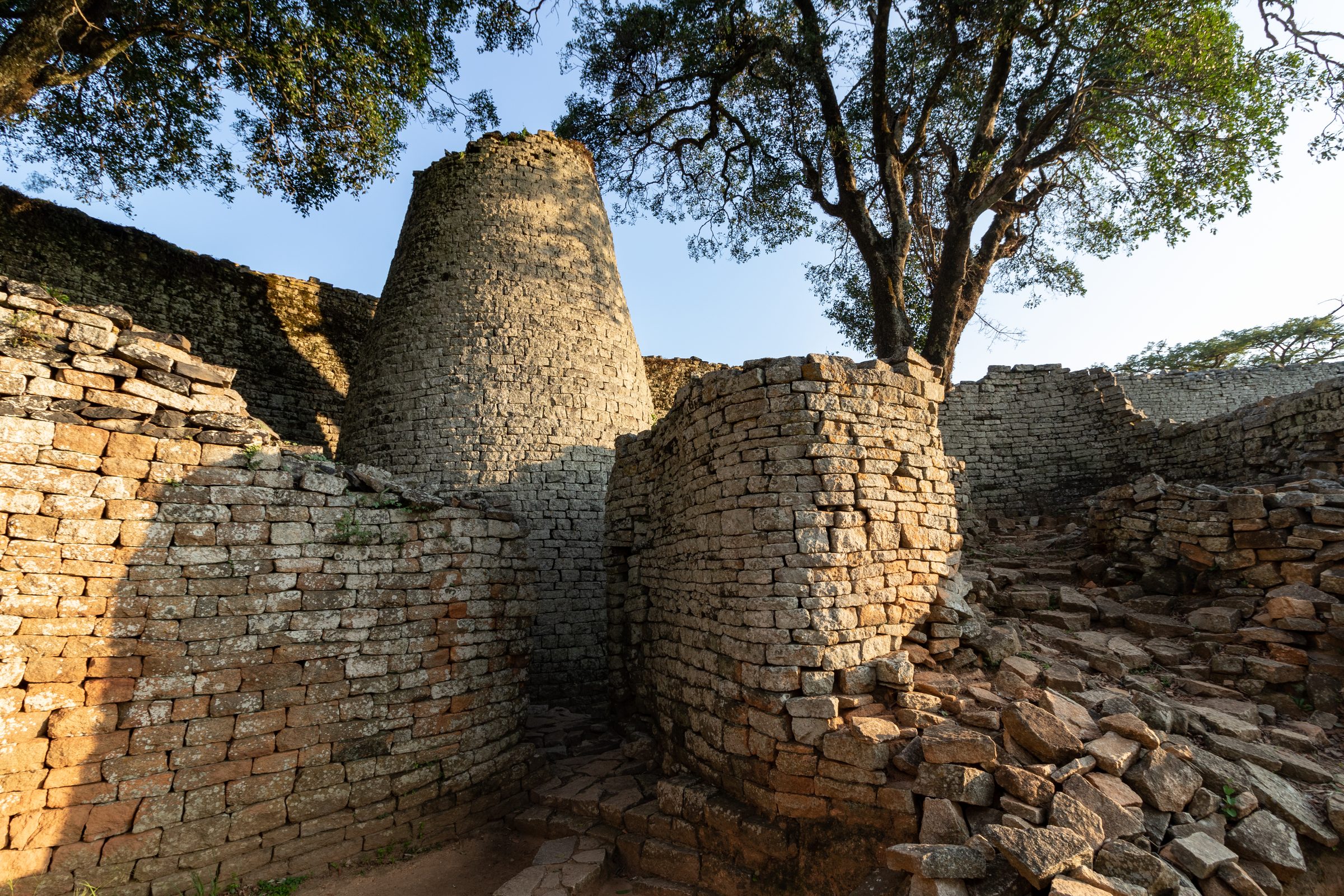
Long before colonial boundaries, this interior participated in extensive commercial networks. Great Zimbabwe, developed between the eleventh and fifteenth centuries by ancestors of Shona-speaking communities, combined monumental dry-stone construction with political authority and trade.
Its walls are evidence of African engineering, not an archaeological mystery requiring an outside explanation.
The Mutapa, Torwa and Rozvi states shaped subsequent regional history. Khami, near Bulawayo, preserves another important stone-built political centre. The nineteenth-century Ndebele kingdom added a further consequential chapter.
British colonial expansion imposed dispossession and racial hierarchy. Minority-rule Rhodesia’s unilateral declaration of independence in 1965 prolonged conflict; liberation movements and negotiations eventually secured internationally recognised independence on 18 April 1980.
Expansion of education and healthcare followed. So did serious ruptures: the Gukurahundi killings in Matabeleland and the Midlands, contested politics, disruptive land redistribution and monetary breakdown. Robert Mugabe’s departure in 2017 brought Emmerson Mnangagwa to power. These histories remain relevant to citizenship, reconciliation and confidence in institutions.
3. What the economy actually produces
The latest World Bank assessment records real economic growth of 8.3% in 2025, following 1.7% in drought-affected 2024. Agriculture’s recovery was central; mining and services also expanded. For 2026, the Bank projects 5.3%, while the IMF projects 5%. Neither forecast is a completed-year result.
The World Bank’s October 2026 country brief places 2025 GDP at approximately US$51.2 billion. Dollar-denominated comparisons require care: statistical rebasing and exchange-rate valuation can change the apparent size of the economy without equivalent changes in household purchasing power.
Tobacco demonstrates Zimbabwe’s production capacity. The 2024/25 production and marketing season delivered about 354.8 million kilograms, worth approximately US$1.2 billion. Output, however, is not the same as farmers’ profitability: prices, contract terms and input costs matter.
Maize is fundamental to food security. Sorghum and millet suit drier conditions; cattle and goats support rural incomes. Sugar, cotton, tea and coffee broaden the agricultural base. Citrus, blueberries, avocados and macadamias offer export possibilities, provided irrigation, certification and cold chains function reliably.
Mining supplies much of the country’s foreign exchange. Gold links large operations with artisanal and small-scale producers. Platinum-group metals support established industrial investment; lithium has brought substantial Chinese participation. Diamonds, chrome and coal remain commercially important.
The question is increasingly how much value stays locally. Processing minerals requires dependable power, water, technical skills and buyers—not simply an export restriction.
Manufacturing already encompasses food, beverages, cement, fertiliser, metal products and textiles. New steel investment adds capacity, but announced capacity must not be confused with sustained production or profitable sales.
4. Money, power and the business day
Zimbabwe Gold, or ZiG, introduced in April 2024, operates alongside foreign currencies, particularly the US dollar. This is a multicurrency economy, not a straightforward return to a single national currency.
Recent stabilisation is meaningful. The Reserve Bank reported annual ZiG inflation below 5% during the first half of 2026. The IMF also recognised improved monetary discipline and exchange-rate stability.
That does not erase earlier losses of savings or automatically restore trust. Businesses must still reconcile the currencies of wages, taxes, supplies and customer receipts. A dollar-priced lease can create difficulties for a tenant earning chiefly in ZiG.
Banks, mobile money and electronic payments support commerce, although affordable long-term credit remains scarce. Digital entrepreneurs can serve payments, retail administration and diaspora transactions; reliable connectivity and workable regulation determine how far those services scale.
Electricity is equally practical. Hwange’s newer generating units have improved supply, while Kariba’s hydropower remains exposed to rainfall and water allocations shared with Zambia. Installed capacity is not continuously available electricity.
Solar generation, batteries and efficient equipment therefore have immediate commercial relevance. The opportunity includes maintenance and financing, not just panel installation. Large proposed solar schemes should remain on the development ledger until funded, constructed and operating.
5. Four neighbours, several routes to the sea
South Africa is Zimbabwe’s most consequential regional commercial relationship: supplier, export market, employment destination and gateway through Durban. Beitbridge is both an economic artery and a reminder that border efficiency affects prices far inland.
Mozambique provides access to the Indian Ocean. The Beira corridor, through Mutare and Forbes–Machipanda, connects Zimbabwe with port, road, rail and fuel infrastructure. Maputo offers another maritime route. These relationships make Mozambique part of Zimbabwe’s operating economy, not merely its eastern boundary.
Zambia connects through Chirundu and Victoria Falls–Livingstone. Commerce crosses the Zambezi alongside tourists, family connections and shared responsibilities for Kariba. Botswana’s links through Plumtree and other crossings support trade, travel and employment; the wider northern tourism circuit connects Zimbabwe with Botswana’s wildlife destinations.
Electricity cooperation through the Southern African Power Pool reinforces these interdependencies. Corridor agreements signed in 2025–26 seek better coordination, but agreements are not proof that congestion or infrastructure deficiencies have disappeared.
Zimbabwe belongs to SADC and COMESA and participates in the African Continental Free Trade Area. Preferential access still depends on applicable tariff schedules, rules of origin and customs procedures. Continental membership does not make every shipment duty-free.
6. The wider world in Zimbabwe’s trade
ZimTrade’s 2024 merchandise figures provide a useful full-year benchmark: exports of US$7.43 billion and imports of US$9.53 billion. Minerals and alloys represented approximately three-quarters of exports; unmanufactured tobacco contributed almost another fifth.
The UAE received 35.7% of exports, South Africa 28.7% and China 13.2%. These are recorded destinations, not necessarily the final consumers of commodities traded through international hubs.
More recent reporting indicates merchandise exports reached US$9.04 billion in January–August 2026, up 60.7% year on year. That partial-year performance should not be presented as a completed annual total.
South Africa and China also lead important supply relationships. In ZIMSTAT’s September 2025 snapshot, they supplied 35.6% and 14.4% of imports respectively. Fuel, machinery, vehicles and electrical equipment illustrate Zimbabwe’s dependence on imported inputs.
European relationships include tobacco and ferrochrome exports, machinery and pharmaceutical imports, and horticultural markets. India’s connections encompass trade, education, technical training and business participation. Chinese investment is particularly visible in minerals and industry; the UAE’s role is strongly associated with gold trade.
Diversification means adding dependable products and customers—not merely increasing receipts when commodity prices rise.
7. Homes, classrooms and family networks
Zimbabwe’s 2022 census shows a predominantly rural society. Yet urban and rural lives overlap: earnings, food, school fees, care responsibilities and visits circulate between them.
Extended families often help organise childcare and support older relatives, although households differ considerably. Rural livelihoods combine cultivation with livestock, trading and income earned elsewhere. Urban life includes formal careers, small businesses, market selling and skilled repair work.
Informal enterprise is neither peripheral nor synonymous with unemployment. It provides goods and services, but many operators need better premises, finance and protection rather than admiration for having to manage without them.
Education remains an important national capability. ZIMSTAT’s census-based adult literacy measure was 93.6%, although its schooling-based proxy does not measure the quality of learning. The University of Zimbabwe and Bulawayo’s National University of Science and Technology support professional and technical development.
Healthcare combines public referral hospitals, district facilities, clinics and private providers. Staff migration, financing constraints and uneven access affect what patients can obtain. Professional competence and system capacity are different questions.
Football, cricket, church activities, music and family gatherings belong in any account of ordinary life. So do aspirations that are entirely recognisable elsewhere: a useful qualification, reliable transport, a home and work that rewards ability.
8. A culture heard, read and shared
Zimbabwe constitutionally recognises 16 languages. Shona and Ndebele are widely spoken, but Tonga, Kalanga, Nambya, Ndau, Venda and other language communities must not disappear inside those larger categories. English has an important institutional role.
Mbira music carries interlocking melodies through metal keys mounted on wood, sometimes within a resonator. Its uses include spiritual practice, remembrance and social enjoyment. UNESCO recognised the shared Malawi–Zimbabwe mbira/sansi tradition in 2020.
Contemporary culture also includes sungura, chimurenga, urban music, comedy and digital media. Heritage is material for new expression, not a requirement that young artists remain stylistically unchanged.
Stone sculpture has established an international reputation, while literature and theatre examine family, power, language and belonging. Charles Mungoshi’s writing across Shona and English illustrates that intellectual range.
At the table, sadza—also known as isitshwala—commonly accompanies vegetables, beans or meat. Groundnuts, small fish and seasonal produce broaden the repertoire. Restaurants and home kitchens continually reinterpret familiar ingredients.
Weddings, funerals and family ceremonies can bring customary practices, religious observance and contemporary clothing together. There is no single national dress code or uniform way of celebrating.
9. The calendar—and the importance of checking it
Bulawayo’s Zimbabwe International Trade Fair remains an active meeting place for industry, government and international exhibitors. Its 66th edition was scheduled for 20–25 April 2026, under the theme “Connected Economies, Competitive Industries”.
Shoko’s official 2026 programme listed 24–26 September in Harare and Chitungwiza, combining music and comedy with technology discussions and community events. Intwasa’s published 2025 programme demonstrates Bulawayo’s continuing multidisciplinary arts infrastructure, including theatre, poetry and women-led performance.
HIFA requires more careful wording. After its last completed edition in 2018, organisers announced an August 2026 return. An announcement alone does not establish that the full festival subsequently happened; its resumption should not be treated as verified here.
Independence Day on 18 April remains a national commemoration. Christmas and Easter are important to many Christian households; Muslim, Hindu and other communities maintain their own observances. Traditional ceremonies follow local calendars and protocols rather than a universal tourism timetable.
Festivals matter economically because artists, technicians, caterers and venues need paying audiences. Cultural continuity also requires viable livelihoods.
10. Landscapes with people in the picture
At Victoria Falls, the Zambezi’s descent into basalt gorges creates spray-fed forest and a shared Zimbabwean–Zambian World Heritage landscape. Water levels change seasonally; the experience cannot be reduced to one permanent postcard.
Hwange’s woodlands and grasslands support elephants, predators and extensive birdlife. Wildlife tourism depends on habitat, water management and the people protecting them.
Mana Pools offers a different relationship with the landscape: Zambezi floodplains, seasonal pools, walking and canoe-based experiences under professional guidance. Its ecology belongs to a river system extending beyond national boundaries.
Matobo’s granite hills hold rock art and living sacred associations. Great Zimbabwe invites attention to architecture and historical imagination, not merely photographs beside walls.
The Eastern Highlands offer walking, mountain scenery and agricultural landscapes around Nyanga, Vumba and Chimanimani. Lake Kariba supports boating, fishing and hospitality alongside power generation and fisheries. Its history also includes displacement, particularly of Tonga communities.
Tourism employs guides, cooks, mechanics, craftspeople and conservation workers. Its strongest development case rests on local participation and ecological stewardship—not arrivals alone.
11. Building, belonging and choosing carefully
For property investors, useful questions concern actual users: housing near employment, serviced commercial premises, tourism accommodation with demonstrable demand, or warehouses along functioning corridors. Asking prices are not completed transactions, and demand does not guarantee collectable rent.
Urban residential and commercial title must be distinguished from agricultural tenure. Farm-tenure reforms are evolving; an offer letter, lease and registered title are not interchangeable. Foreign participation, transferability and collateral value require transaction-specific legal verification.
ZIDA facilitates investment, but company registration, sector licences and immigration permission remain separate matters. Foreign ownership is possible in many activities, while reserved sectors and participation conditions require current checks. Profit-repatriation provisions do not remove banking and foreign-exchange execution risks.
Commercial possibilities include food processing, irrigation services, mineral-processing support, distributed energy, logistics and digital services. Each depends on customers, inputs and enforceable arrangements. Approved investment licences are not realised foreign direct investment.
For residents, Harare offers the broadest concentration of corporate services and international schooling; Bulawayo combines education, industry and cultural life. Mutare and Victoria Falls suit different professional economies. Harare International School offers the International Baccalaureate continuum, but school places and fees require direct confirmation.
A realistic household budget must include housing, transport, healthcare, schooling and any backup water or power. No dependable single “expatriate monthly cost” describes these different circumstances. Work and residence permission must be established separately from property ownership.
Belonging is similarly more complex than nationality. India’s government distinguishes approximately 8,500 Zimbabweans of Indian origin from around 1,500 Indian expatriates. Regional migration has also produced longstanding family connections with Malawi, Mozambique and Zambia. European-origin Zimbabweans and newer foreign residents should not be conflated; neither should Chinese companies be treated as demographic evidence about Chinese residents.
Zimbabweans abroad sustain another national network, particularly through South Africa, Britain, Australia and the United States. Recorded diaspora remittances reached US$2.45 billion in 2025. Behind that total are school payments, care, construction, enterprise and relationships maintained across distance.
Zimbabwe’s constraints remain consequential: public debt arrears, uneven services, expensive finance and questions of regulatory predictability and accountable government. Recent stabilisation deserves recognition; lasting confidence requires consistency.
The country is neither an investment thesis awaiting discovery nor a problem awaiting interpretation. Its people already produce, create, study and organise. The serious question is whether institutions, infrastructure and capital will increasingly allow that work to accumulate into secure homes, stronger businesses and greater freedom to plan.
In the library
Sources / research notes
- Macro Poverty Outlook, ZimbabweWorld BankOctober 2026 outlook. Real GDP growth of 8.3% in 2025 and 1.7% in 2024, a 5.3% projection for 2026, and GDP of US$51.2 billion in current dollars.
- Zimbabwe country pageWorld BankRecords growth of 1.7% in 2024 and 8.3% in 2025, led by agriculture and mining prices.
- External trade, September 2025ZIMSTATThat month, South Africa supplied 35.6% of imports and China 14.4%.
- Art of crafting and playing Mbira/SansiUNESCOInscribed in 2020 on the Representative List, shared by Malawi and Zimbabwe. A wooden board with metal keys, sometimes set in a resonator.
- Press release, 28 June 2025Embassy of India, Harare · 28 June 2025Estimates approximately 10,000 persons of Indian origin in Zimbabwe. It does not print the 8,500 and 1,500 split used in the article.
- Zimbabwe exports by country, 2024UN COMTRADE, via Trading EconomicsFull-year merchandise exports of US$7.43 billion and imports of US$9.53 billion.
Editorial review
The World Bank figures in section 3 match the October 2026 Macro Poverty Outlook: 8.3% real growth in 2025, 1.7% in 2024, a 5.3% projection for 2026, and GDP of about US$51.2 billion. The IMF’s 5% projection for 2026 is quoted in reports of an October 2026 Fund statement and of the World Economic Outlook. The Fund’s own release was not retrieved, and the sentence is unchanged.
A press report of the Tobacco Industry and Marketing Board’s 2025 season close gives 353,016,666 kilograms, valued at US$1,172,936,458. The article’s “about 354.8 million kilograms” was not matched to that table. “Approximately US$1.2 billion” sits near the reported value. The kilogram sentence is flagged and left as written.
The 2024 export and import totals match the COMTRADE compilation above. Minerals and alloys at about three-quarters, and unmanufactured tobacco at almost a fifth, are consistent with 2024 figures reported in the Zimbabwean press (about US$5.56 billion and about US$1.33 billion). The UAE share of 35.7% matches reported exports of about US$2.65 billion, and South Africa near 28.7% matches about US$2.14 billion. China’s 13.2% share was not on a primary table opened for this publication. It is flagged, and the sentence is unchanged.
Exports of US$9.04 billion in January–August 2026, up 60.7%, are carried in press reports of ZIMSTAT figures. A ZIMSTAT workbook for that eight-month total was not opened. The article already presents the figure as recent reporting, and it is unchanged.
Press accounts of the Reserve Bank’s 2026 second-quarter snapshot put annual ZiG inflation at 4.7% at the end of June, and say it stayed below 5% from January. The Bank’s PDF was not retrieved. Recorded remittances of US$2.45 billion in 2025 are reported from the 2026 Monetary Policy Statement; that statement was not opened. Both sentences are unchanged.
ZIMSTAT’s census education announcement, as reported in October 2022, gave a national literacy rate of 93.7% for people aged 15 and above who had completed at least Grade 3. The article says 93.6%. The figure is flagged and left as written. The census description of a predominantly rural population was not re-tabulated here.
The Embassy of India estimates about 10,000 persons of Indian origin and does not distinguish 8,500 Zimbabweans of Indian origin from 1,500 expatriates. That sentence is flagged and unchanged.
The Zimbabwe International Trade Fair’s 66th edition, 20–25 April 2026, and the theme “Connected Economies, Competitive Industries” are confirmed in reporting of the fair’s own calendar. Shoko’s 24–26 September 2026 programme, Intwasa’s 2025 programme, the HIFA announcement of an August 2026 return, and Harare International School’s International Baccalaureate continuum were not opened on the organisers’ pages. The article already withholds verification of HIFA’s resumption. The other three programme claims are flagged and unchanged.