Who typically looks here
Households whose job or university is in the capital, and buyers who want a specific London submarket rather than a British city in general.
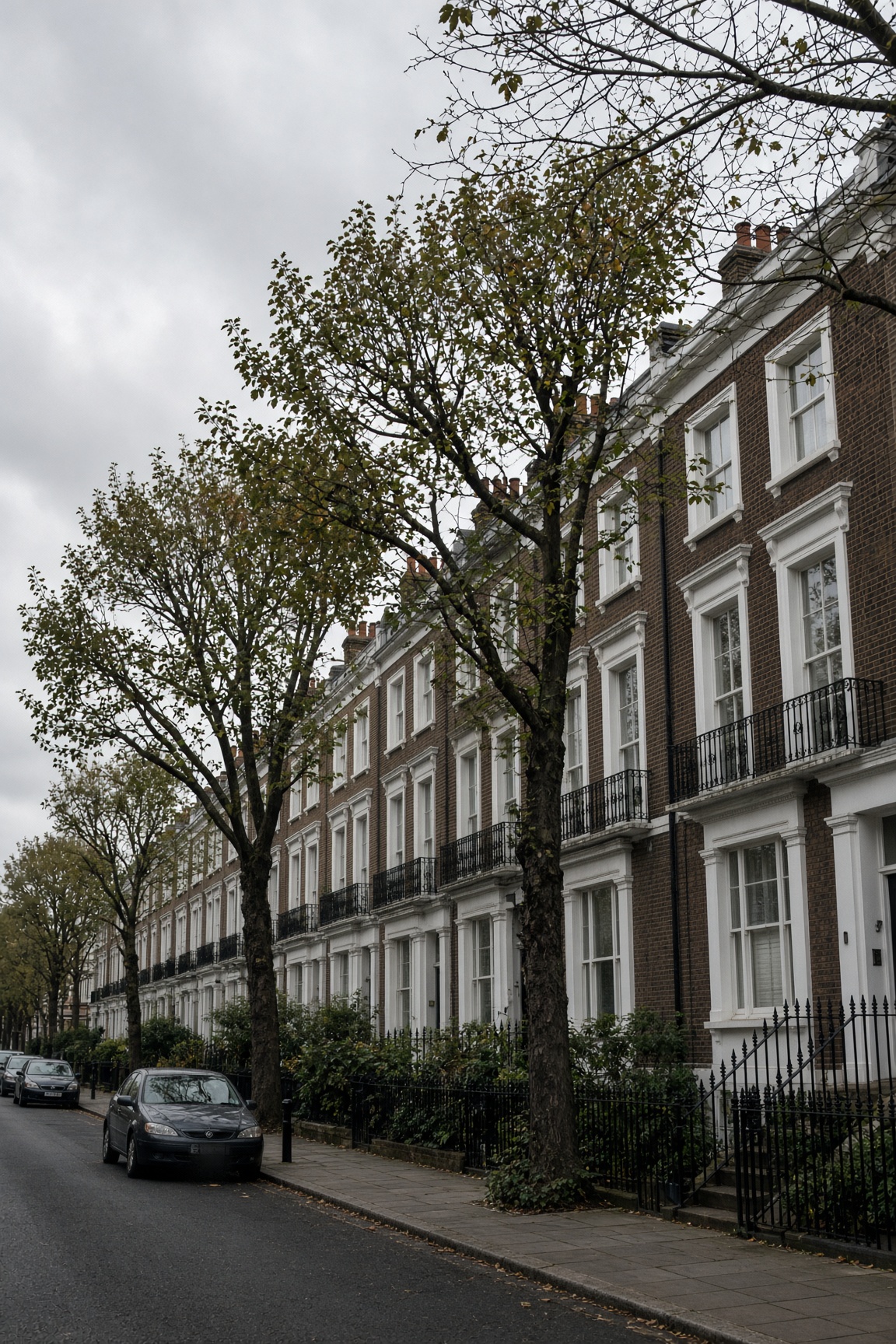
MarketsUnited KingdomLondon
London is not a single property market. Prime central stock, an outer-borough house and a new apartment beside a station do not share a buyer, a lease or an exit.
The United Kingdom page is the country: tax that is not the same in Scotland or Wales, a northern city with its own employers, and a visa that is filed apart from the title. This page is only the capital, and the capital is already several markets. Averaging them is how a London brief goes wrong.
What follows separates the central label from Greater London, the places people work from the places they rent, new towers from the older stock, and the lease and the service charge from the address. No neighbourhood is ranked. No property is recommended.
Households whose job or university is in the capital, and buyers who want a specific London submarket rather than a British city in general.
Which part of London, whether the title is freehold or leasehold, and which tenancy rules apply if someone else will live there.
A set of submarkets inside one city. The country brief still does the work of comparing London with the rest of the UK.
Each section carries the date it was last reviewed and the documents it was read against.
Prime Central London is a market label, not a line on a title plan. Agents usually point it at a small set of central boroughs, Westminster and Kensington and Chelsea among them, sometimes with adjoining streets in Camden. The label does not make those streets one product. A lateral flat, a house on a garden square and a mansion flat with a short lease can share a postcode and still have different buyers, different running costs and different exits.
The buyer pool here is more international, and more often able to transact without a local mortgage, than the pool for an ordinary family house in an outer borough. That describes who turns up. It does not make the district one asset, and it does not rank the streets. Mayfair, Knightsbridge, Chelsea, South Kensington and Notting Hill do not clear in the same way in a quiet quarter.
Planning, conservation and the freeholder still decide what can be done to a building. Much of this stock sits in a conservation area, or includes a listed building, under the Planning (Listed Buildings and Conservation Areas) Act 1990. The designation is a local record. A prime address does not relax it, does not relax building-safety law, and does not shorten a lease.
No price, yield, rent or tax rate is printed. Neighbourhoods are distinguished, not ranked.
Greater London is 32 boroughs and the City of London. The City is its own local authority, separate from the City of Westminster. The Mayor and Transport for London sit above the boroughs for transport and for the London Plan. Housing enforcement, planning applications and much of daily administration sit with the borough named on the decision. A flat in Newham and a house in Richmond are both in Greater London. They are not in the same market.
Inner and outer are useful as commuting words. They are a poor way to underwrite a building. Some inner boroughs are dominated by flats and renting. Some outer boroughs are houses, schools and a rail trip. A riverside tower in an inner borough can be a weaker resale than a terrace in an outer one, or the reverse, depending on who the buyer is.
The London Plan, published in March 2021, is the Mayor’s statutory spatial development strategy. Borough local plans are written against it. The Plan is a direction for land and housing across the capital. It is not a rent for a flat, and a decision on a planning application is still taken by the borough named on the form, except where the Mayor calls the application in. The country brief is where London is set next to other British cities. This page stays inside the capital, and refuses to average it.
No price, yield, rent or tax rate is printed. Neighbourhoods are distinguished, not ranked.
Housing demand in London follows where the week is spent. The City of London is a financial and professional district with a thin residential population of its own. The Corporation’s planning baseline, using the 2021 census, records 8,600 usual residents and describes the weekday population as mostly people who commute in. A flat in the Square Mile is a small housing market beside a large employment market. Canary Wharf and the Isle of Dogs are a second office market, built as large floorplates rather than as a historic street. The West End mixes retail, professional firms and culture. King’s Cross is a regenerated employment district beside mainline stations. Hospitals, universities and the civil service hold other large payrolls, scattered rather than stacked in one square mile.
The London Plan gives that split a boundary. Policy SD4 is the Central Activities Zone, the concentration of government, culture, retail and professional firms. The Plan treats the Northern Isle of Dogs as a satellite of that zone for world-city offices, and it names both the City of London and the Northern Isle of Dogs as nationally important locations for financial and business services. A flat described as ‘near the City’ can be a long journey from either.
Heathrow’s employment sits in the west, not in the centre. A household whose job is there is not bidding for the same evening as a household whose job is on Lombard Street. The City of London Corporation is the local authority for the Square Mile. Tower Hamlets is the local authority for Canary Wharf. A firm can employ people in both, and the housing question is still which desk has to be reached, on which days. Hybrid work changed how often some desks are occupied. It did not abolish the Monday when a team is required in a building, and it did not make every borough equidistant from that building.
A residential brief that starts from ‘London jobs’ has skipped the question. Which payroll, which days, and which line actually reaches it.
No price, yield, rent or tax rate is printed. Neighbourhoods are distinguished, not ranked.
London’s private rented sector is large because the city is large, young in its working-age inflows, and expensive to buy relative to a single salary. The tenants split by the week they occupy: a corporate let near an office core, a room let to a student, a family renting an outer house, and a short stay in a furnished flat. The paperwork often splits with them.
In England the private tenancy itself has changed. The Renters’ Rights Act 2025 received Royal Assent on 27 October 2025. The House of Commons Library records that, from 1 May 2026, assured shorthold tenancies in the private rented sector converted to periodic assured tenancies and section 21 notices ceased to be the route to possession. Possession runs through grounds. That is an England statute. It is not the private residential tenancy in Scotland, and it is not the Welsh occupation contract. A landlord who underwrites a London flat on the old right to end a tenancy at term-end is using a rule that the commencement date removed.
None of this produces a rent, a vacancy rate or a yield. Those depend on the building, the week, and the costs that sit under the rent: service charge, insurance, tax, and empty time. Boroughs can also require a licence. Mandatory licensing of larger houses in multiple occupation sits in the Housing Act 2004, and a council may add an additional or selective scheme of its own. A let that needs nothing in one borough can need a licence in the next. This page does not estimate the rent or the fee.
A further registration is opening for private landlords in England. The government announced on 9 September 2026 a ‘register your rental property’ service under the Renters’ Rights Act. It launches on 15 December 2026 in the West Midlands, then moves through other regions over the following year. Landlords who are already letting are the first group required to sign up. A London date is the date London is called forward, not the West Midlands date. The register is not the short-term let scheme described on the holiday-home guidance, which that page still marked as not yet in force.
No price, yield, rent or tax rate is printed. Neighbourhoods are distinguished, not ranked.
An individual can buy a home in England without a nationality bar of the kind that shapes several of the Asian markets on this site. That openness is not a tax exemption, and it is not immigration permission. The right to live in the flat is a visa question. The right to own it is a conveyancing question. They are filed separately on the UK page as well.
Where the buyer is an overseas company, the Register of Overseas Entities applies. Companies House requires the beneficial owners to be registered before the entity can buy, sell or charge UK land. The register has been in force since 1 August 2022. An individual buying in their own name is not that filing. Using a company so that the name on the title is offshore is a different legal and tax object. The annual tax on enveloped dwellings can apply to a dwelling held that way, above the threshold on the HMRC page. The threshold is not copied here.
Stamp Duty Land Tax, not a London levy, is charged on residential purchases in England and Northern Ireland. Additional-dwelling rates exist. A non-resident surcharge exists, and it uses its own day-count test, not the statutory residence test used for income tax. The return can have to assume non-residence if the days are not yet accumulated. Rates move. They are not printed here. Wales and Scotland charge different transaction taxes, which is one reason a London price cannot be dropped into a UK average.
No price, yield, rent or tax rate is printed. Neighbourhoods are distinguished, not ranked.
A new apartment is a contract with a developer, then a lease in a building that does not yet have a service-charge history. Completion can move. Snagging appears after the keys. The warranty is a product sold with the building, not a statute and not a promise that a lender will treat the block as it treats a house on a street. Incentives at the point of sale can make the headline price a weak comparable for the flat next door.
Ground rent on most new long residential leases in England and Wales is restricted by the Leasehold Reform (Ground Rent) Act 2022. That statute does not repair an older lease whose ground rent already rises. A new tower and a Victorian conversion can stand on the same road and carry different documents.
Some districts absorbed a great deal of apartment construction in a short period: parts of the south bank and Nine Elms, parts of the royal docks, and a number of town centres further out. Naming them is a supply observation, not a preference. When several buildings complete together, that postcode’s resale and letting are a local event. They are not a statement about London.
No price, yield, rent or tax rate is printed. Neighbourhoods are distinguished, not ranked.
Most of the capital is not a new tower. Terraces, semis, mansion blocks and converted houses are the ordinary stock, much of it built before the current building regulations and before the current idea of a service charge. Condition is the first question: structure, damp, windows, and what the last survey actually opened. Age is not a defect. Unexamined age is.
A house is usually freehold. A flat in that same terrace, once converted, is usually leasehold, with a share of repair costs and a lease that gets shorter. They are neighbours, not substitutes. Post-war estates and interwar suburbs have their own buyers, often people who live in the borough rather than people comparing the flat with a second city.
Building safety cuts across both new and old stock, but it bites hardest on taller residential buildings. Section 65 of the Building Safety Act 2022 defines a higher-risk building, for the occupation regime in England, as one that is at least 18 metres in height or has at least seven storeys, and that contains at least two residential units. The 2023 regulations take some buildings out of that definition, including a building that consists entirely of a hotel. A mansion flat below the threshold, and a freehold house, sit outside it. A tower that meets it is a different file from both. The building-safety papers, not the year the marketing was printed, decide whether a lender will proceed. An established block with a clean set of accounts can be easier to read than a new one that has not yet had a major-works year.
No price, yield, rent or tax rate is printed. Neighbourhoods are distinguished, not ranked.
The Elizabeth line is open. The Northern line extension to Nine Elms and Battersea Power Station opened to passengers on 20 September 2021. The Overground holds together orbital trips that used to be awkward. Transport for London runs those networks, and the Underground. Many of the suburban trains into the main termini are National Rail, a different operator and a different disruption. A commute that uses both is only as reliable as the worse half.
A station that is operating changes who can live in a neighbourhood and still arrive at a desk. A line that is proposed, or a station that is promised, is a different fact. The second is not treated as if it were the first. Transport does not rank neighbourhoods. It sorts them by the trip a particular household makes. A faster train into the City helps a City worker. It does little for a nurse whose hospital is in the other direction, or for a household whose constraint is a school rather than a platform. The relevant test is that trip, at the hour it happens, including the walk at the far end.
Where the opening and a cluster of new towers happen together, as at Nine Elms and Battersea, the resale and the letting are a local event. They do not describe the next borough.
No price, yield, rent or tax rate is printed. Neighbourhoods are distinguished, not ranked.
Most London flats are leasehold. The buyer owns a right for a term of years, not the land in the way a freehold house is owned. The term left, the ground rent if the lease is old enough to have one, the service charge and the reserve fund are part of the price. A short lease is a wasting right. Extending it is a statutory process with a cost, not a favour from the freeholder, and the Leasehold and Freehold Reform Act 2024 changes parts of that process only as they are brought into force. The Act on the statute book and the Act in force are not the same document.
A share of freehold usually means the leaseholders also own the company that holds the freehold. The flat is still held on a lease. It is not the same object as a house. Commonhold exists in statute and is rarely how a London flat is actually owned.
Service charges pay for insurance, staff, lifts and works. Large works require consultation under the Landlord and Tenant Act 1985. Accounts for the last years, and any notice of works not yet billed, belong in the pack before exchange. A charge the leaseholder thinks is unreasonable can be taken to the First-tier Tribunal (Property Chamber). That right does not pause the bill while the case is open, and it does not explain a building-safety cost sitting beside the ordinary service charge. This is a document problem. It is not solved by the address.
No price, yield, rent or tax rate is printed. Neighbourhoods are distinguished, not ranked.
London’s universities are a real source of housing demand: University College London, Imperial, King’s, the London School of Economics and a long list of others, spread across more than one borough. Naming them locates the demand. It does not pick a street. A student looking for a room near a campus and a couple renting a flat for three years are different occupiers. A shared house is often a house in multiple occupation, with the licensing that implies. Halls and many purpose-built student buildings are an operating business, often on a licence or a student contract, not a buy-to-let flat on an assured tenancy. Read which contract the building uses before treating the rent as if it were a private let.
Professional demand follows the employment centres above, and the hospitals. It is strongest where the journey to the desk is ordinary and the flat can be let to one household. A Monday-to-Friday corporate tenancy and a student house-share do not survive the same change in the law or the same empty summer. Under the English periodic tenancy, the holding period is no longer a fixed term you can simply wait out.
No price, yield, rent or tax rate is printed. Neighbourhoods are distinguished, not ranked.
London’s resale pool is deeper than that of a small British city. Depth is still local, and it is measured in completed transfers at HM Land Registry, not in the number of flats still on a developer’s website. A house with a clear freehold and a broad domestic buyer is a different exit from a one-bedroom flat in a new building, which may depend on a mortgage valuation, a service-charge budget and a building-safety file. Where those papers are slow, the flat is slow, even if the street is famous.
Cash is more common in some central stock. It can make a sale possible when a lender will not proceed, and it can disappear in a quarter when that buyer steps back. Neither case is a London-wide liquidity statistic. This page does not publish one.
The rest of the country is not a thinner copy of this market. Manchester, Leeds, Birmingham and the Scottish cities have their own employers and their own resale, and Scotland does not use English leasehold or English stamp duty. That comparison lives on the United Kingdom page. A London reading that ignores it will treat the capital as if it were the country.
No price, yield, rent or tax rate is printed. Neighbourhoods are distinguished, not ranked.
Related GRIP research
These are GRIP briefs, not city reports. They sit next to a London reading.

Real estate research
Freehold, leasehold, strata, quota, company. The words are dull. They are also the asset.
Brief3 September 20262 min read

Startup investing
Startups, headquarters and industrial parks do not just need offices. They rearrange housing, hospitality and the next street.
Brief19 July 20262 min read

Investment basics
A long hold is a design: cash, condition, and a reason to still want the asset later.
Brief29 June 20262 min read
Across GRIP
The same place, read from another desk.
Also in United Kingdom
Continue with GRIP
If this city belongs on the list, write to GRIP, or return to the country brief.