India
Bengaluru
The deepest pool of product and export-engineering employers. The city is also a municipal system under strain.
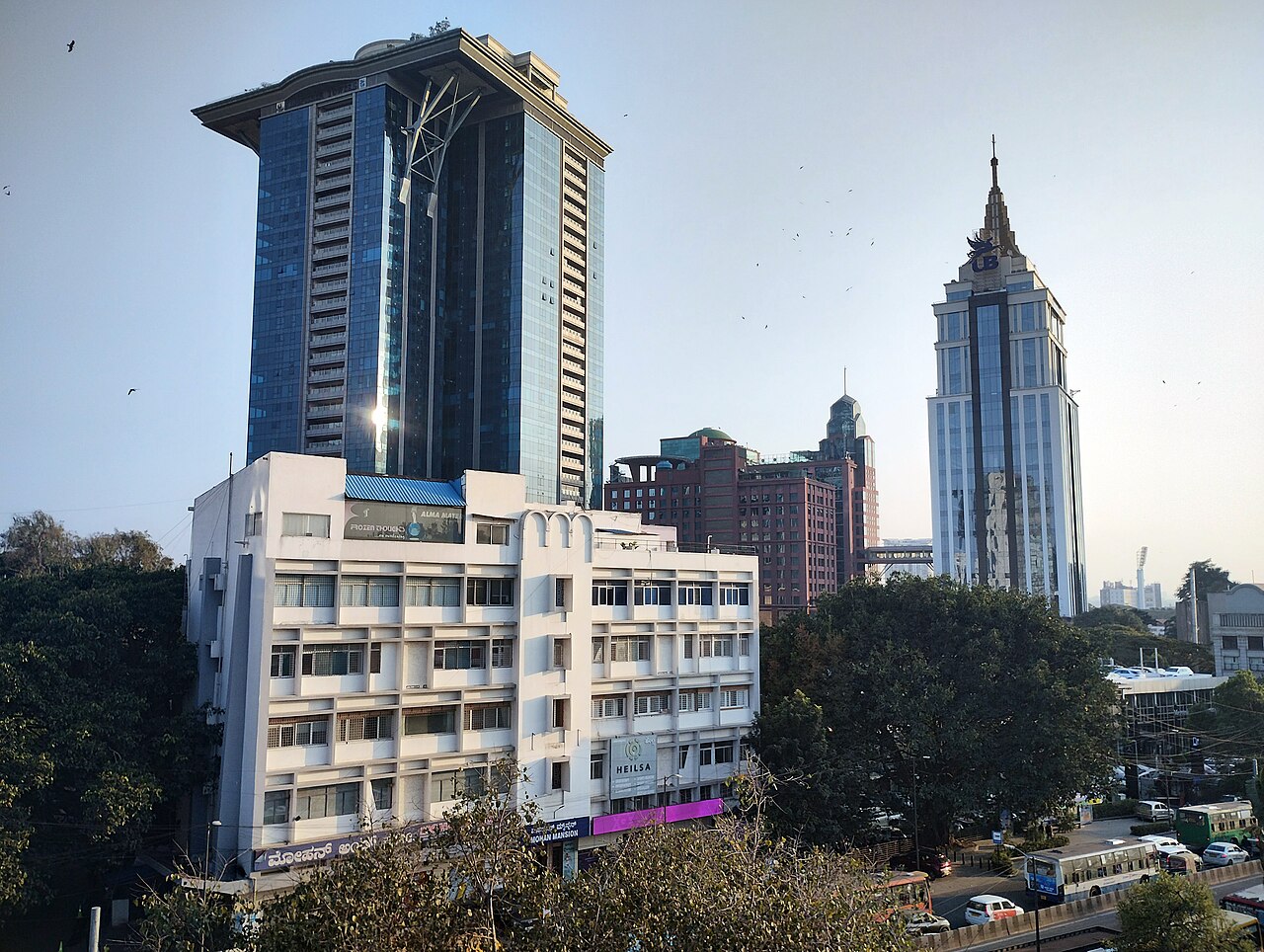
Startup EcosystemsIndiaBengaluru
Engineering labour market
Role in the system
Bengaluru is India’s main market for people who have already built software for a living. Export-services firms, captive engineering centres of foreign companies, and product startups hire from the same pool and sit in the same southern and eastern corridors. That mix is the city’s advantage and its wage-setter.
It is not the financial capital and it is not the political capital. Founders who need a regulator’s building or a ministry’s corridor still get on a plane. What they can do here is hire, and lose people to the campus next door.
Where firms actually sit
The municipal city and the tech corridors are not the same map. Older commercial towers, including the ones in the photograph, are not the same labour market as the outer campuses. Whitefield, the Outer Ring Road, and Electronic City developed as separate employment zones. Commuting between them is an operating constraint, not a colour on a slide.
Karnataka’s own startup and IT policies sit on top of central company law. A state incentive is not incorporation, and it can change with the government. Read the current state notification before treating a park address as a strategy.
Talent and campuses
The Indian Institute of Science is in the city. Engineering colleges across Karnataka and the rest of the south feed the employers. The more important institution is the services firm that trained the mid-level engineer the startup wants to hire.
Senior product, design, and research roles are scarcer than graduate engineers. Companies compete with Bangalore’s captives, which can pay a multinational salary without asking the employee to take startup risk. That outside option is part of the cost of building here.
Capital
Investors travel to the city because the companies are here, not because a stock exchange is. Fund managers may be registered in Mumbai, in GIFT City, or abroad. The term sheet is not a Bengaluru document even when the office is.
Local angel networks exist and are not a substitute for a SEBI-regulated fund when the money is pooled from the public’s proxies. The licence follows the vehicle, not the coffee shop.
Infrastructure
The airport is a functioning international gate. The roads between employment zones are the daily constraint. Water, in a city that grew faster than its reservoirs and its pipes, is an operating fact for campuses and for households. Neither point needs a commute-time statistic to be part of a location decision.
Power and fibre inside the established campuses are a different standard from the rest of the metropolis. A company that only sees the campus will misread the city its employees go home to.
Scale and the limit
A product company can reach national users from Bengaluru because distribution for software is not the city’s roads. A company that has to deliver goods, install hardware, or collect cash still inherits India’s logistics. The engineering centre does not, by itself, solve that.
The limit specific to this city is organisational: keeping people when a captive centre can hire them, and building a second layer of managers who have shipped a product rather than staffed a client account. That is a hiring problem.
Also in India
Capital and the financial centre
Mumbai
SEBI, the exchanges, and the people who allocate Indian savings. Engineering density is not the reason to be here.
Three jurisdictions, one labour draw
Delhi-NCR
The political capital plus Gurugram and Noida. Policy customers, corporate headquarters, and three different state systems.
Services, life sciences, and a state project
Hyderabad
A planned technology district and a life-sciences corridor in Telangana, with a different cost structure from Mumbai or Bengaluru.
Factories, a port, and a research park
Chennai
Tamil Nadu’s commercial capital. Software, hospitals, and an automotive and electronics belt are different industries that share a city.
An engineering and manufacturing city
Pune
Automotive and mechanical engineering on one map, software parks on another, and a financial capital a few hours away that it should not imitate.
Smaller urban systems
Emerging centres
Cities where one piece of the stack is real: a factory, a college, a port, or a state incentive. Each place is named for that function.
Across GRIP
Elsewhere in the research
The same place, read from another desk.
- Startup EcosystemsCities in this systemThe country file lists the cities in the order they are discussed.
- Real EstateHow a building is readUse, tenure and the building itself.
- EconomyIndia economyIndia is filed first as a company-formation system. The economy a founder meets is not yet a GRIP property market.
- InfrastructureIndia infrastructurePublic digital infrastructure changed how a firm starts. It did not abolish roads, power, ports, or the distance between Indian cities.
- Startup EcosystemsIndia startup ecosystemCompany formation, capital, and scale. Property is a separate file.
- RelocationLiving in IndiaA visa, a job, and a title are separate permissions. The week that would be lived comes before the deed.
- Global InvestmentEmerging is a classificationOfficial groupings exist to organise data. They are revised, they overlap, and they do not carry a required return or a required risk.
- Global InvestmentDemography is slow, and it is localAge structure and urban settlement shape housing need over decades. They do not time a purchase, and a national trend is not a city.
Continue with GRIP
Read the country rulebook next.
A city can hire. It cannot invent a different companies act, a different sanctions regime, or a different exchange control.