India
Hyderabad
A planned technology district and a life-sciences corridor in Telangana, with a different cost structure from Mumbai or Bengaluru.
Startup EcosystemsIndiaHyderabad
Services, life sciences, and a state project
Role in the system
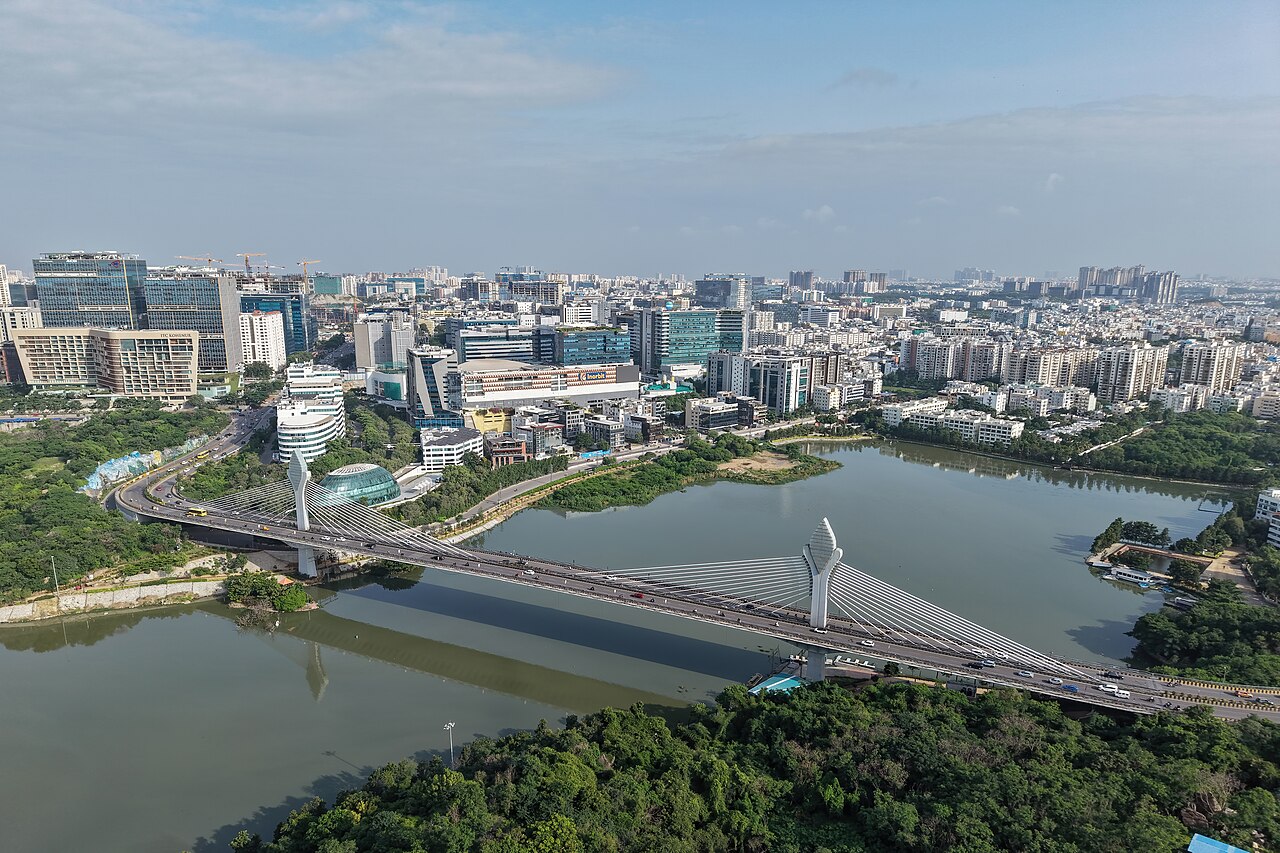
Hyderabad is a state capital that built a technology employment zone and, separately, a life-sciences cluster. HITEC City, in the photograph, is the visible commercial result of the first. The life-sciences geography is not the same set of buildings. Collapsing them into one ‘innovation district’ hides the difference between an IT-services campus and a laboratory economy.
After the bifurcation of Andhra Pradesh, Hyderabad remained the capital of Telangana. State policy is therefore Telangana policy. Incentives, land, and the tone of administration follow that government.
Two technical bases
The larger employer is technology and business-process services, including large captive centres. Product startups hire from that base, as they do in Bengaluru, usually at a different pay and a different depth of experienced product managers.
Life sciences are the distinctive second base: research campuses, contract research, and manufacturing of a kind Bengaluru does not lead with. A software company and a formulations company do not need the same licence, the same talent, or the same investor. The city’s advantage is that both conversations are locally possible.
Talent and universities
The University of Hyderabad, IIIT Hyderabad, and the Indian Institute of Technology Hyderabad (which sits outside the central city, at Kandi) are different institutions. IIIT Hyderabad is research-intensive and small. IIT Hyderabad is a newer IIT, not a shorthand for the whole hiring market. Most technical staff still come from a much wider college system and from the services firms.
Cost of living relative to Mumbai and Bengaluru is why companies put centres here. The trade is senior-specialist depth. Some roles will still be hired in another city and flown in. Plan for that instead of discovering it.
State and centre
Incorporation is still a Ministry of Corporate Affairs act. Telangana’s industrial and innovation policies are a layer of land, stamp duty, and publicity. Publicity is not a title. Ask which incentive is a notification with a budget, and which is only a press line.
The same caution applies to any named park. A park can be well run and still be the wrong building for a laboratory, or a services campus with no product culture. Visit the specific estate.
Access to markets
Hyderabad firms sell services to foreign clients, pharmaceutical products into a regulated national and export market, and, less automatically, consumer products into the Telugu-speaking states and beyond. Those are three commercial motions.
The city is well connected by air to the other Indian metros and to the Gulf. It is not a port city. Physical export goes through other people’s logistics. For software that is irrelevant. For a manufacturer it is the point.
Scale and the limit
Hyderabad can host a large employment campus. Whether it can host the full stack of a product company, including the people who have shipped one before, depends on the sector. In life sciences the stack is more local than outsiders expect. In consumer internet it is often a centre inside a company whose decisions sit in Bengaluru, Mumbai, or abroad.
That second pattern is not a failure. It is a description. A city can be an excellent operating base and a poor place to pretend you have the whole firm.
Also in India
Engineering labour market
Bengaluru
The deepest pool of product and export-engineering employers. The city is also a municipal system under strain.
Capital and the financial centre
Mumbai
SEBI, the exchanges, and the people who allocate Indian savings. Engineering density is not the reason to be here.
Three jurisdictions, one labour draw
Delhi-NCR
The political capital plus Gurugram and Noida. Policy customers, corporate headquarters, and three different state systems.
Factories, a port, and a research park
Chennai
Tamil Nadu’s commercial capital. Software, hospitals, and an automotive and electronics belt are different industries that share a city.
An engineering and manufacturing city
Pune
Automotive and mechanical engineering on one map, software parks on another, and a financial capital a few hours away that it should not imitate.
Smaller urban systems
Emerging centres
Cities where one piece of the stack is real: a factory, a college, a port, or a state incentive. Each place is named for that function.
Across GRIP
Elsewhere in the research
The same place, read from another desk.
- Startup EcosystemsCities in this systemThe country file lists the cities in the order they are discussed.
- Real EstateHow a building is readUse, tenure and the building itself.
- EconomyIndia economyIndia is filed first as a company-formation system. The economy a founder meets is not yet a GRIP property market.
- InfrastructureIndia infrastructurePublic digital infrastructure changed how a firm starts. It did not abolish roads, power, ports, or the distance between Indian cities.
- Startup EcosystemsIndia startup ecosystemCompany formation, capital, and scale. Property is a separate file.
- RelocationLiving in IndiaA visa, a job, and a title are separate permissions. The week that would be lived comes before the deed.
- Global InvestmentEmerging is a classificationOfficial groupings exist to organise data. They are revised, they overlap, and they do not carry a required return or a required risk.
- Global InvestmentDemography is slow, and it is localAge structure and urban settlement shape housing need over decades. They do not time a purchase, and a national trend is not a city.
Continue with GRIP
Read the country rulebook next.
A city can hire. It cannot invent a different companies act, a different sanctions regime, or a different exchange control.